
Arabba Marmolada Ski Map
Offers the highest altitude in the circuit (up to 3,269m on Marmolada glacier) with challenging runs and great snow, ideal for advanced skiers.
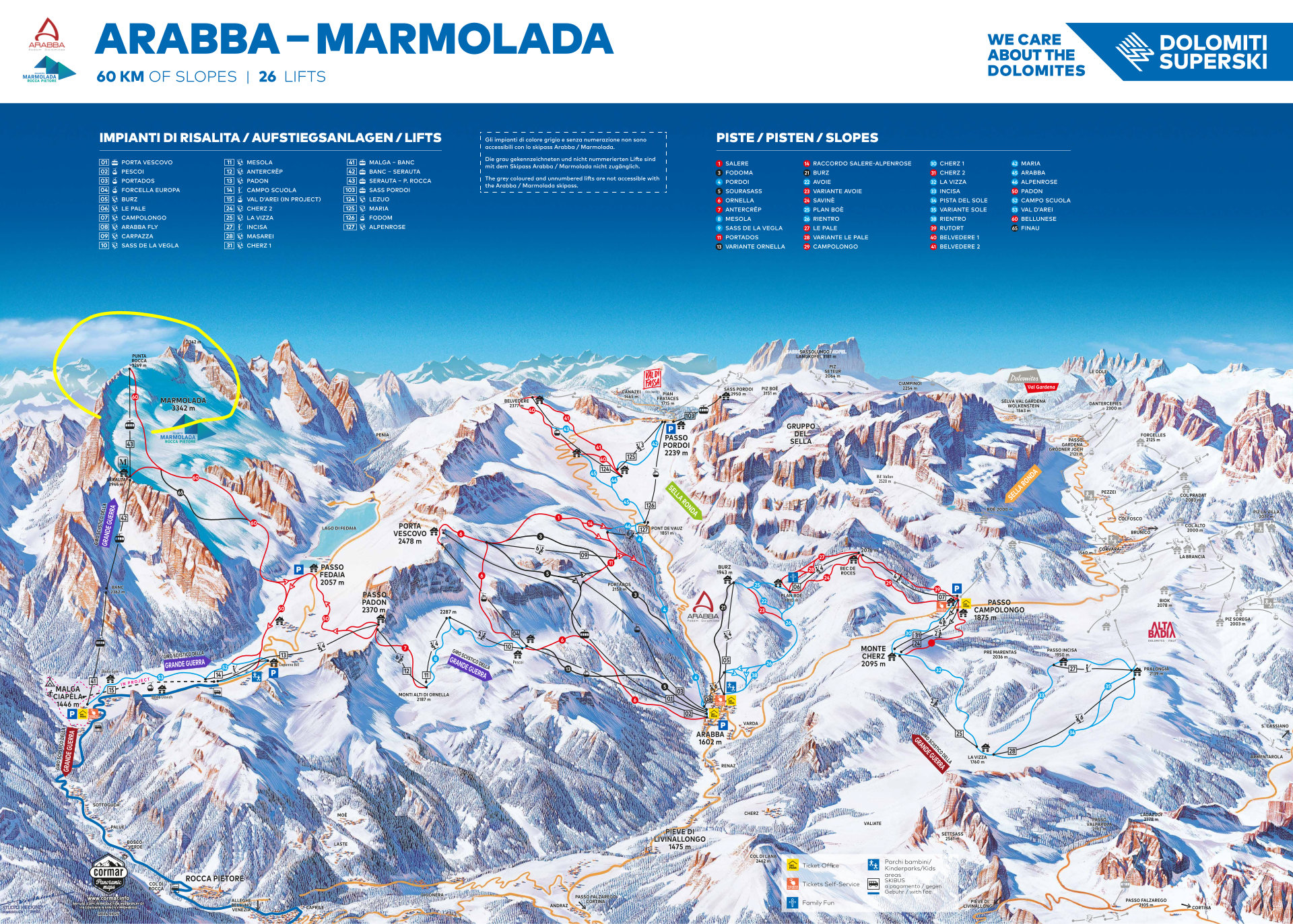
The famous red piste (La Bellunese) from the top of Marmolada is a long, world-class intermediate run (Red #60), not overly steep but challenging due to its length (12km), high altitude, potential for bumps and ice in afternoon sun, and narrow sections, making it suitable for confident intermediates, especially in the morning.
Difficulty Breakdown:
Intermediate-Friendly Gradient: The slope offers a consistent, medium gradient, described as “pure adrenaline” but generally manageable for intermediates, not requiring expert skills.
High Altitude: At nearly 3300m, expect cold, windy conditions and thinner air, which can affect stamina and caution.
Afternoon Challenges: Go early! By midday, especially on busy days or later in the season, the piste can develop significant bumps (moguls) and icy patches, making it much harder.
Narrow Sections: Some parts of the run, particularly at the start, are narrower, requiring good control.
Long & Exposed: It’s one of Italy’s longest runs (12km), with a significant vertical drop (1800m), so endurance matters.
Key Takeaway:
It’s a fantastic experience for intermediate skiers looking for a long, scenic run, but it’s not for nervous beginners or those who prefer easy blues. Aim for a morning start to enjoy it at its best.
https://www.skicorvara.com/corvara-arabba.php
The route from Corvara to Arabba is part of the clockwise route around the Sella Ronda. The quickest and easiest way – which is described on this page – can also be extended somewhat by taking advantage of some of the interesting runs on the eastern side of the Passo Campolongo if time is not a factor.
The single route out of Corvara is via the Boè gondola which rises to 2000m in altitude. From here there is a lengthy red back down to the village or the option of taking an easyish but sometimes crowded black run from the top of the Vallon chairlift.
Those heading directly for Arabba will want to take the red run directly down to Passo Campolongo. From the tiny settlement on the road there is a choice of heading up into the extensive ski area on the other side via one of the Cherz chairlifts, or of taking the link through to the Bec de Roces on the Campolongo chairlift (a Dolomiti Superski pass is necessary to use this lift as it is part of the neighbouring Arabba area).
This whole area has an extremely attractive “out-of-the-way” feel to it and, while the skiing is not to extensive, it is nonetheless a collection of pleasant red runs with some beautiful scenery.
The return to La Villa is once again via the Pradüc chairlift and up the newer Sponata chairlift. From the top it is possible to ski into La Villa and cross the road to the bottom of the Piz La Ila gondola.
What are the best blue runs in the Arabba Marmolada Ski area
Arabba is famous for being the most challenging sector of the Sella Ronda, dominated by steep north-facing reds and blacks. However, there are some excellent pockets of blue runs if you know where to look—particularly on the sunnier side toward Passo Campolongo and near Passo Pordoi.
Here are the best blue runs in the Arabba-Marmolada area:
Here are the best blue runs in the Arabba-Marmolada area:
1. The Monte Cherz & Passo Campolongo Sector
This is the “blue heaven” of Arabba. Unlike the steep Porta Vescovo side, these slopes are sunny, wide, and perfect for cruising.
- Piste #22 (Cherz I): A classic, wide blue that runs from the top of the Monte Cherz chairlift down toward Passo Campolongo. It is gentle and usually in excellent condition.
- Piste #26 (Incisa): A lovely, easy run that connects the Cherz area back toward the Burz sector. It’s ideal for those who want to avoid the steeper reds but still travel across the mountain.
- Piste #38: A scenic blue that helps you navigate the lower sections of the Burz mountain back into the village.
2. The Passo Pordoi & Pont de Vauz Sector
If you head toward the Val di Fassa side, you’ll find high-altitude, open blue terrain.
- Piste #4 (Pordoi): This is a key part of the green (anti-clockwise) Sella Ronda. It is a long, gentle blue that skirts the bottom of the Porta Vescovo sector. It’s a great way to enjoy the high-alpine scenery without the vertical drop of the black runs.
- Piste #8 (Mesola): Accessible via the Mesola chairlift, this is a fantastic “hidden” blue. It starts at 2,270m and offers panoramic views of the Sella Massif. It’s often much quieter than the main Sella Ronda routes.
3. The Malga Ciapela (Marmolada Base) Sector
While the Marmolada glacier itself is famous for its long red (the Bellunese), the very bottom of the valley has some beginner-friendly terrain.
- Pistes #14 & #15: These are short, very easy blue runs located right at the base in Malga Ciapela. They are perfect for practice, though because they are low and south-facing, they can get slushy in the afternoon.
Important Tips for Blue-Run Skiers in Arabba:
- Avoid the “Rientro” late in the day: The blue run back into Arabba village (the Rientro) can become very crowded and “choppy” by 3:00 PM as everyone returns from the Sella Ronda. If you’re tired, consider taking the Burz chairlift back down.
- The “Gap” to Marmolada: There is no blue-run-only way to get from Arabba to the Marmolada glacier. To reach the glacier, you must navigate Red #50 (Passo Padon). If you aren’t comfortable with reds, it’s better to stay on the Campolongo/Cherz side.
- Head to Alta Badia: If you find Arabba too intimidating, the blue runs in neighboring Alta Badia (Corvara/Colfosco) are world-class and just a couple of lifts away via Passo Campolongo.
Arabba is often considered the “hardest” sector of the Dolomites. While other areas might over-grade their runs, Arabba’s reds are authentic and often sit right on the boundary of being black, especially by the afternoon when they become icy or mogul-filled.
Here are the best red runs in the Arabba-Marmolada area, along with a “difficulty warning” for each:
Here are the best red runs in the Arabba-Marmolada area, along with a “difficulty warning” for each:
1. La Bellunese (Marmolada Glacier)
This is the most famous run in the Dolomites—a 12km descent from Punta Rocca (3,269m) down to Malga Ciapela (1,450m).
- The Vibe: High-alpine, wide, and spectacular. It feels like an epic journey rather than just a ski run.
- Is it bordering on Black? Not for steepness, but for endurance. The pitch is a consistent intermediate grade, but its sheer length (7.5 miles) will make your legs scream. The real “black” danger here is the weather; if the clouds roll in, the lack of trees makes it a white-out nightmare.
2. Ornella (#6)
Running directly under the main Porta Vescovo gondola, this is the backbone of Arabba’s north-facing slopes.
- The Vibe: Long, sustained, and usually has the best snow in the valley because it’s north-facing and shaded.
- Is it bordering on Black? Yes, the top section. The very first pitch coming off the Porta Vescovo ridge is notoriously steep. Many intermediates find this start intimidating. Once you get past the initial “wall,” it settles into a beautiful, rhythmic red.
3. Salere (#10)
This run branches off the Porta Vescovo ridge and heads toward the Fodom chairlift/Passo Pordoi area.
- The Vibe: A great alternative to the Ornella, offering a slightly different perspective of the valley.
- Is it bordering on Black? Moderately. It is less consistently steep than the Ornella, but it is the main “escape route” for those doing the Sella Ronda (Orange route). This means it gets heavily trafficked, often ending the day with large “sugar” mounds and icy patches that make it feel much harder than a standard red.
4. Burz (#21/24)
Directly across the valley from Porta Vescovo is the Burz mountain.
- The Vibe: Sun-soaked and fast.
- Is it bordering on Black? Run #24 definitely is. The middle section is narrow and surprisingly steep. It is often used as a “test” run for people staying in Arabba village. If you can handle Burz comfortably in the afternoon when it’s slushy or bumped, you can handle almost any red in the Dolomites.
5. Padon (#50/51)
These runs are the “gateways” you must use to get from the Arabba side over to the Marmolada glacier.
- The Vibe: High-altitude ridge skiing.
- Is it bordering on Black? No, but they are “tricky.” These runs are south-facing. In the morning, they can be bullet-proof ice; by 2:00 PM, they can be heavy, grabby slush. They aren’t “black” in gradient, but they require good technical skill to navigate the changing snow conditions.
Summary Table: Difficulty Check
| Run Name | Level | “Black” Factor |
| La Bellunese | Solid Red | Stamina. 12km is a serious leg-burner. |
| Ornella | Deep Red | Initial Steepness. The first 200m are very steep. |
| Burz (#24) | Red/Black | Technicality. Narrow and steep in the middle. |
| Salere | Solid Red | Traffic. Becomes very bumpy/mogul-heavy by 3 PM. |
Export to Sheets
Would you like me to suggest a specific route that connects these reds into a full-day “Advanced Intermediate” tour?
For an “Advanced Intermediate” day in Arabba, the goal is to conquer the high-altitude glacier of the Marmolada while the snow is crisp, then spend the afternoon on the challenging north-facing slopes of Porta Vescovo where the snow stays firm even when the sun is out.
This route avoids the flat sections of the Sella Ronda and focuses purely on high-quality red descents.
The “Queen & The Ridge” Itinerary
Phase 1: The Glacier Morning (The Marmolada)
08:30 – Early Start: Take the Europa I & II gondolas from Arabba up to the Porta Vescovo ridge.
The Connection: Ski down Red #10 (Salere). It’s a wide, scenic red that leads you toward the Passo Padon.
The Crossing: Take the Passo Padon chairlift. From the top, you have a long, sweeping red descent (#50) down to Malga Ciapela.
Black Border Warning: This run is south-facing. If it’s a cold morning, it can be very icy.
The Peak: Take the three-stage Marmolada cable car to Punta Rocca (3,269m). Take 10 minutes at the top—the 360° view is the best in Italy.
The Long Descent: Ski La Bellunese (#60). It’s 12km of pure red bliss.
Phase 2: Lunch with a View
Where to Eat: On your way back from the glacier, stop at Rifugio Padon. It sits right on the ridge and offers a direct view of the Marmolada glacier you just skied. It’s famous for its pasta and sun terrace.
Phase 3: The Technical Afternoon (Porta Vescovo)
After taking the chairs back up toward Arabba, spend your afternoon on the steep north face.
The Ornella (#6): This is the “king” of Arabba reds. It is north-facing, meaning the snow stays “grippy” and fast all day.
Black Border Warning: The top 200 meters are very steep and often develop large bumps by 2:00 PM. Keep your weight forward!
The Alpenrose (#1): If your legs are still feeling strong, this red is slightly wider than Ornella but still offers a great vertical drop back into the village.
Phase 4: The Final Challenge
Burz (#24): Cross the village via the Arabba Fly (the chairlift that goes over the road) and head up the Burz chairlift.
The Descent: Take the red back down.
Black Border Warning: This run is south-facing and often becomes “slushy” and heavy by late afternoon. Navigating heavy snow on a steep pitch is a great way to test your technical skills before your final après-ski drink.
Itinerary Summary
Time
Location
Difficulty Note
09:30
Marmolada Summit
High altitude, can be windy.
11:00
La Bellunese (12km)
Pure stamina; not overly steep.
13:00
Lunch @ Rifugio Padon
Spectacular glacier views.
14:30
Ornella Red
Steep top section; borders on black.
15:30
Burz Red
Heavy snow/moguls in the afternoon.
Blacks in Arabba
Arabba is the undisputed “black run capital” of the Dolomites. While most of the Sella Ronda is famous for wide, cruising blues and reds, the Porta Vescovo face (the steep, north-facing wall directly above Arabba) is where your friends will find the real adrenaline.
Unlike many “vanity” black runs in the Alps, Arabba’s blacks are authentic, long, and often icy due to their northern orientation. Here are the must-ski blacks for your friends:
1. Fodoma (#3)
The “Queen” of Arabba. This is widely considered one of the most technical and challenging runs in the entire Dolomiti Superski area.
- The Vibe: A long, sustained descent with a massive vertical drop (over 800m).
- The “Black” Factor: It features a maximum gradient of 56%. The central section is a legitimate “wall” that looks like a precipice when you’re standing at the top. Because it’s north-facing, the snow is often hard-packed and “bulletproof,” requiring sharp edges and serious technique.
2. Sourasass (#5)
Often called the “big sister” to the Fodoma, this is a slightly longer but marginally less steep variant on the same face.
- The Vibe: Highly technical and winding. It follows the natural contours of the mountain, making it feel like a more “raw” experience than the wide, groomed Fodoma.
- The “Black” Factor: While the average gradient is slightly lower than Fodoma, it is still very steep. Its main challenge is the twists and turns; it’s a high-speed technical workout that doesn’t give your legs a break until you reach the valley floor.
3. Burz (#21)
This run is on the opposite side of the valley from the main Porta Vescovo face (the sunny side).
- The Vibe: Short, sharp, and intense. It’s the run your friends can lap while you enjoy a coffee at the Burz hut.
- The “Black” Factor: This is south-facing. In the morning, it is often a sheet of ice. In the afternoon, the sun turns it into a field of giant moguls (bumps). It is surprisingly steep and, because it’s narrower than the runs across the valley, it can feel very claustrophobic when busy.
4. Ornella-Sourasass Raccordo
This is a high-speed “link” or variant that splits off from the red Ornella run.
- The Vibe: A great way to combine the speed of a red with the technical difficulty of a black.
- The “Black” Factor: It allows skiers to bypass the middle “cruising” sections of the red and stay on the steepest fall lines of the mountain.
Pro-Tips for the Black Run Group:
- The “Cold Start” Advantage: Because these runs are north-facing (except Burz), they hold their shape much longer than the Sella Ronda. Your friends should hit Fodoma and Sourasass in the late morning once the light has improved but before the Sella Ronda crowds have scraped the snow away.
- Edge Check: If their skis haven’t been serviced recently, Arabba’s blacks will find them out. The snow here is often “injected” or naturally very hard-packed.
- The “Arabba Fly” Shortcut: If you are staying on the blue/red side (Burz/Campolongo) and they want to nip over for one black run, they can use the Arabba Fly chairlift to cross the town in 2 minutes without walking.
Should I help you coordinate a meeting point where your blue/red routes intersect with these black runs for a group lunch?
Meeting Back Up In Arabba
Finding the perfect meeting point in Arabba is a bit of a puzzle because the steep “Black” face (Porta Vescovo) and the gentle “Blue” area (Campolongo/Cherz) are on opposite sides of the valley.
To make this work, I’ve selected three meeting points where your routes physically intersect, allowing the groups to split and rejoin without anyone getting lost.
1. The “Top of the World” Meeting: Rifugio Luigi Gorza
This is the most spectacular option. It sits right at the top of the Porta Vescovo ridge (2,478m).
- For the Blue/Red Group: Take the Porta Vescovo Funifor (a large cable car) from the village. It lets you off right at the hut. You can then take the cable car back down to avoid the steep slopes, or ski the easier Red #10 (Salere).
- For the Black Group: They can ski the Fodoma (#3) or Sourasass (#5) blacks, which both start right outside the front door.
- The Vibe: High-end, modern, and has a terrace with the best view of the Marmolada glacier.
2. The “Village Level” Meeting: Rifugio Burz
This hut is located on a sunny plateau just above the Arabba village. It’s the most convenient spot if you want to meet quickly.
- For the Blue Group: Take the Burz Chairlift up. You can enjoy a coffee on the terrace and ski a short, easy blue path back down.
- For the Black Group: The Black Burz (#21) run ends directly at the village, and the chairlift to the hut is right there. It’s perfect for them to do “laps” while you relax.
- The Vibe: Trendy, famous for its outdoor hot tub and great gourmet burgers.
3. The “Mid-Mountain” Meeting: Rifugio Bec de Roces
Located toward Passo Campolongo, this is the best spot if you are spending the day moving between Arabba and Alta Badia.
- For the Blue Group: This hut is easily reached via the gentle Blue #22 or #26.
- For the Black Group: There aren’t many blacks here, but it’s a great “reunion point” after they have finished the intense runs on the other side of the valley and want to join you for the rest of the day in the sunnier, easier terrain.
- The Vibe: Traditional, rustic, and very family-friendly.
Recommended Lunch Strategy:
I suggest meeting at Rifugio Luigi Gorza at the start of your lunch break.
- Everyone takes the big cable car up together.
- Enjoy the view and a meal.
- After lunch: The Blue group takes the cable car back down (saving their legs), while the Black group “drops off the edge” to ski the Fodoma back to the village.
